Another interview for the Brighton newsletter, this time a writer/performer bringing an extremely thought-provoking show to The Yellow Book.
It’s so interesting to me that Mazzon’s “in” for this story was Tarot cards! Everyone seems to know the (probably apocryphal) tale of the female Pope – Sergeant Buzfuz certainly did – but this is a much more interesting story, and one with some historical weight to it also.
The show is on Saturday 30th November, and the interview is republished below.
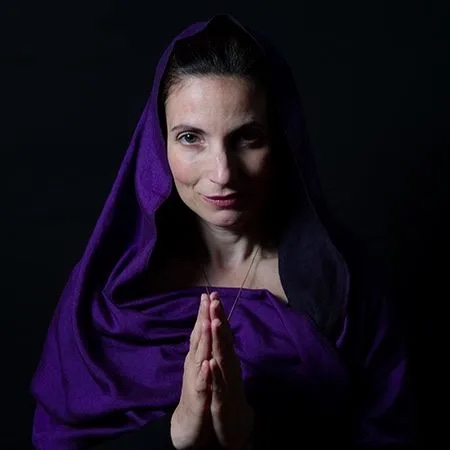
Hello! Who are you and what on earth are you bringing to Brighton?
My name is Elena Mazzon, I am an Italian-British actress and writer bringing my latest play, The Popess, to Brighton for the first time!
How did you get started in acting and performance?
I started acting back in Italy while I was studying at university and I soon got the theatre bug and started training daily and performing as much as I could with local and national theatre groups.
How did you come across the specific story of the Guglielmites heretical sect in the first place, and what themes caught your eye?
I was reading the meaning of the major arcana tarot cards and as I started reading the story behind the card of the High Priestess I was startled and thought: this is it! My new story about a feminist heresy in 13th Century Milan!
I was always drawn to anything that had to do with mysticism, and I initially wanted to write a play about the witch hunt period. Then I encountered Maifreda (The Popess) and Guglielma’s story and the mystery which encapsulated their lives was simply impossible to resist.
I had never heard of a heresy led by women and that put women centre stage with the belief that salvation would happen only thanks to the feminine. Women (and men) who claimed that God could not only be Father but also Mother. Absolutely unprecedented and so, so relevant!
What can audiences expect from the show?
It is not a usual play: there is some interaction with the audience (don’t panic, no one is dragged on stage!), a certain closeness with them, and I like to deal with the subject matter in a light way.
It’s a thrilling story that raises many questions about power, belief, and gender. Also tbh societal organisation in general – what modern-day parallels do you think the show draws attention to?
I think an important aspect of the play is seeking freedom inside oneself. We are often drawn to believe that authority lies outside of us, but rather (like all medieval mystics said) authority (hence freedom) lies inside ourselves.
We are masters of our destiny and lives. It is often convenient to rely on external authority to make decisions for ourselves (a government, a family member, a boss) so that we do not take any responsibility for our life choices.
Reconnecting with our inner authority enables us to be fully responsible and hence free.
Nowadays, in my opinion, there is a huge need to awaken to this principle and start to create a new world from our own lives!
I saw the Popess at the WIP stage and it was a wonderful and fascinating piece – how has it been performing it, and has the Popess changed or developed through repeat performance?
It has been a great journey so far! I have developed the piece with director Colin Watkeys, with whom I had already worked on my first solo-show.
The process of the work with Colin involves several stages, one of which is a sharing with the audience when we can gather feedback. The feedback was paramount to further develop the piece, clarify some points that were blurred in my head (and writing) and to finalise the dramaturgical structure of the play.
I’m fascinated by the idea of heresy, though in modern day times a lot of the heresies seem more secular in nature (eg not believing in neoliberal capitalism, or hierarchical-based patriarchal society). Do you think the way that norms are policed is more subtle or, I don’t know, insidious these days?
I think since society has evolved and changed, the ways certain beliefs and constraints are imposed on people are different too. Surely more subtle and maybe disguised as well.
And there are different “idols” or “dogmas” these days that are not necessarily connected to religion.
Growing up Catholic (and having a nun headmistress at my junior school!) was a relatively un-traumatic experience for me, but I realise this wasn’t the case for a lot of people. What’s your view on the modern state of the church?
I grew up in a society that was only Catholic on the outside. For instance I remember I was forced (by my non religious mother) to do my confirmation (following 2 long years of doctrine!) because that was the way to do things and because everyone else was. But generally there wasn’t a strong catholic influence in our lives.
I have always felt that the Church has always been too involved in secular matters and very little with spiritual ones. We are possibly facing a crisis now similar to that of the Middle Age! 🙂
As an Italian in the UK, have you met much in the way of prejudice and resistance to you as a performer in these post-Brexit days?
I personally haven’t felt prejudice or resistance since Brexit. As a foreign actor though, it has always been challenging to find my place. There are never enough roles written for foreign parts or that could be played by an actor coming from a background other than British.
And finally, what next for the show, and for you?
The Popess is going to America in May and June- New York first then some touring; I will be in Rome in early Autumn (2025 is a Jubilee year!) and I keep my fingers crossed for Milan, where The Popess and the congregation were actually from!
The Popess is on at Yellow Book on Saturday 30th November at 7:30pm. Advance tickets are available here.
 jamesofwalsh
Leave a comment