Note – this article originally appeared in the Morning Star newspaper
The migration and refugee crisis will not end. Western-backed imperial wars, climate change, and internecine religious, ethnic and factional struggles rage on. Desperate humans will continue to try to reach the metropole, regardless how many fascist politicians we elect or off-shore processing centres we build.
The only answer is empathy, solidarity, and genuine internationalism. And to build a coalition for this, we need to hear the stories of the people who will continue to traverse those people-smuggling routes through remote mountains and across dangerous seas.
Occasionally, photojournalism cuts through, as with the image of two-year-old Alan Kurdi on the Mediterranean beach in Bodrum. But with the traditional press dominated by the billionaire right, more innovative approaches are needed.
Art is one answer. The Phoenix Arts Space in Brighton is currently host to Stories of Migration, an exhibition celebrating twelve years of storytelling by PositiveNegatives, a SOAS-based not-for-profit which describes itself as a “global visual research organisation”. It puts together animations, comics and graphic novels, and podcasts about pressing social, environmental and humanitarian issues.
And this kind of work can have a significant impact in our fragmented media landscape. One animation about the African drugs trade, made in collaboration with the BBC, was watched by 90 million people in a week.
Co-curated by Daniel Locke and Dr Benjamin Worku-Dix, this small space just off the main road to the sea cannot do justice to the range of stories collected and curated by the organisation and its ethnographic researchers, animators, and illustrators. As is increasingly the modern way, this exhibition is almost a gateway, via a series of QR codes, into a series of stark, affecting, and interconnected worlds.
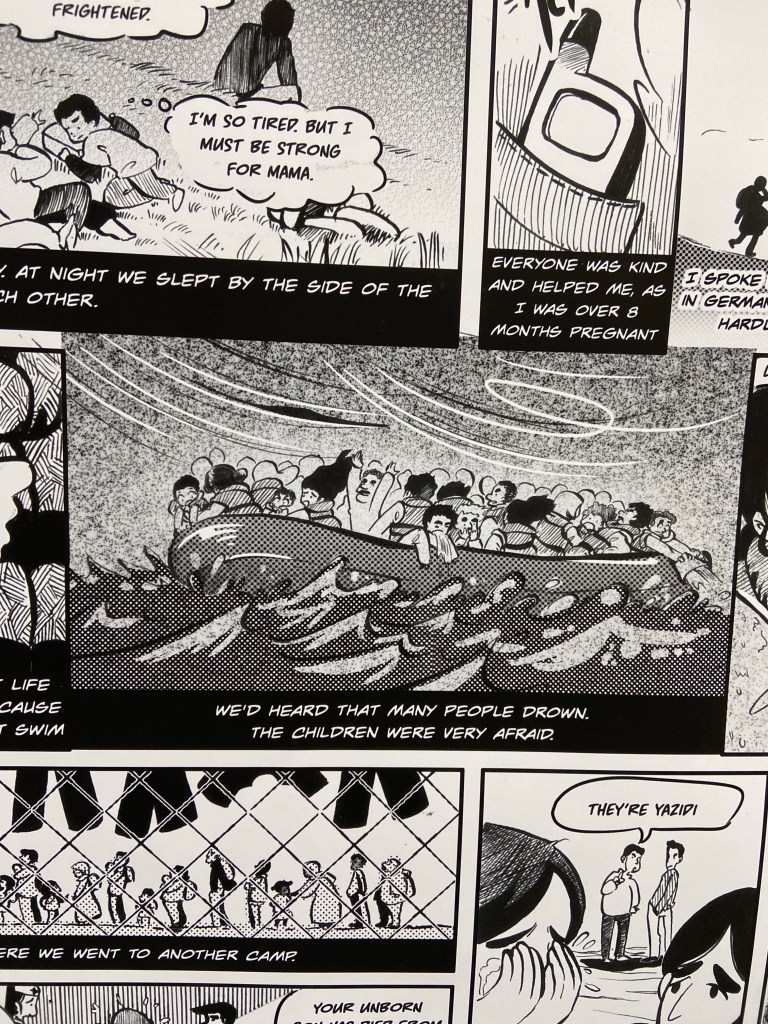
Take Nadia’s Story, a three page, manga-influenced comic illustrated by Asia Alfasi. Commissioned by CARE International UK, this is one of two first person, illustrated testimonies of the terrible difficulties faced by Syrian refugees.
Nadia is Yazidis, a Kurdish-speaking endogenous religious group, the vast majority of them concentrated in Northern Iraq.
When ISIS came to Mosul in the wake of our catastrophic Iraq War, Nadia had no choice but to flee.
Over three pages, we learn of and feel horrors that would be much less immediate in other art forms: young Yazudi girls being burnt alive in cages by rampaging extremists, the horrors of sailing a tiny dingy across to Greece, and the indifference and then open hostility shown to them by their new guardians and guards in the West.
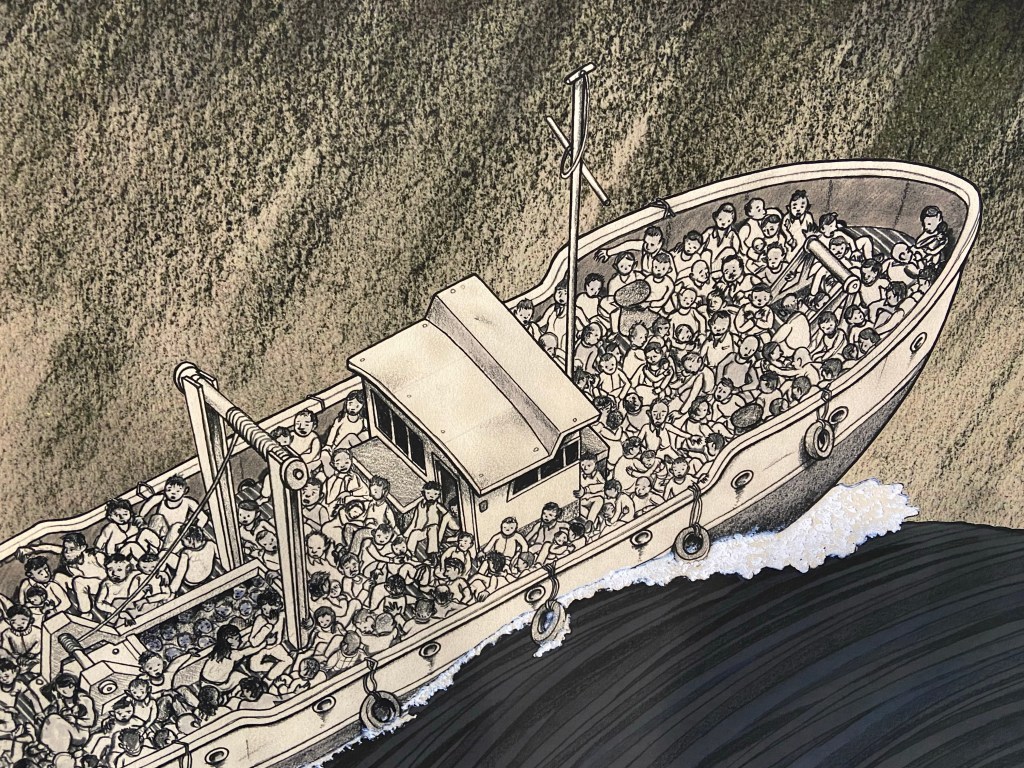
Lesser-known conflicts are also covered. The story of the horrific 2009 Civil War in Sri Lanka, in which tens of thousands of Tamil citizens were brutally killed, has very much been buried by powerful interests, both national and private, with strategic and business interests in the country.

Beautifully illustrated by Lindsay Pollock, VANNI is a graphic novel with the complexity and scope of Joe Sacco’s best work. We see kids losing legs to landmines, and ordinary people trying to do the best for their families, forced into terrible decisions that may result in them never seeing their neighbours or their homelands again.
It also focuses on the ordinary people caught in the crossfire, a valuable testament to the complex and grim realities of modern warfare.
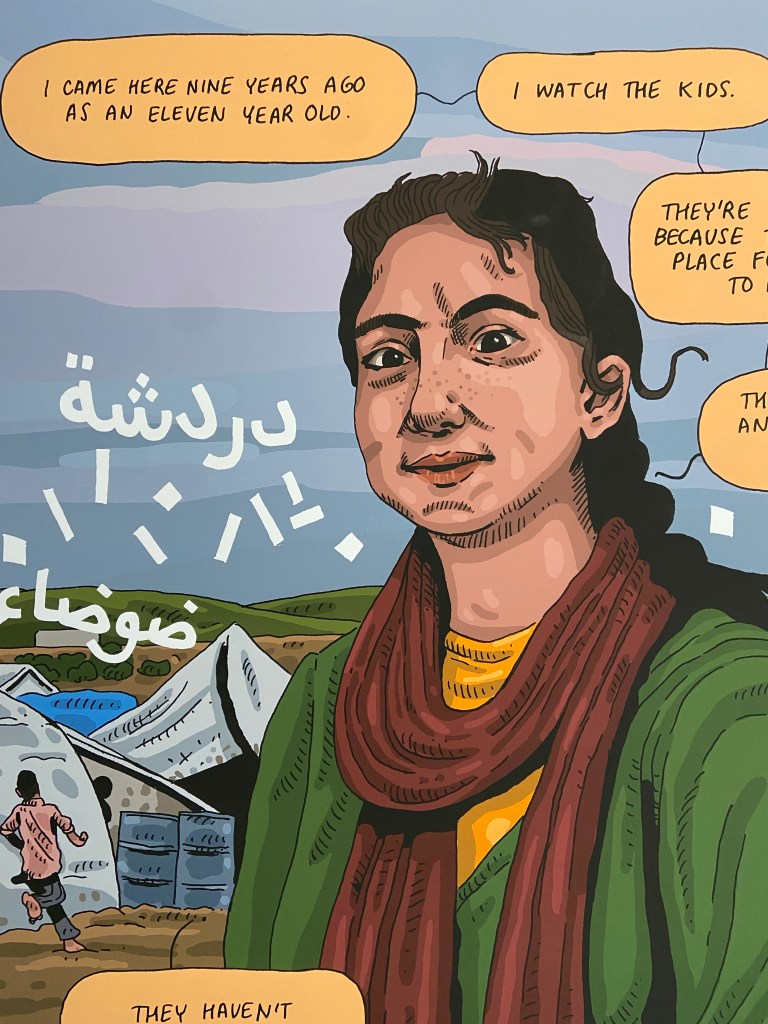
More innovative still is “Where Do I Live”, a collection of stories from female-headed families living in camps across Northern Iraq.
Again due to the limited space, the Phoenix Arts Space presents us with one, compelling panel of a young woman forced into a leadership position within one of these camps, desperately trying to give the young men and boys trapped there structure and meaning.
Go online, and you read the full nine-panel story, illustrated by Dan Locke.
Again, it’s a much more truthful and messier depiction of post-America Iraq than you see most anywhere else:
“A diverse mix of refugees and returnees; they come from a variety of ethnicities and faiths, from Syrian, Yazidi, Kurdish, Sunni and Christians…”
Stateless children, zero information, lack of basic human dignity, dirty water and sewage everywhere, and an international community absolutely abdicating themselves from responsibility for these people ruined by decades of imperial adventures and their consequences.
Once again, the graphic novel allows an immediacy to these stories that is hard to portray in any other medium.
As one 19 year old woman says, who has been in the camp since she was eleven years old: “the house I had there [in Syria], ISIS blew it up. If I go back, I will have to set up a tent, and here in the camp, I also live in a tent. So what’s the difference?”

If one does make the trip to Brighton for this important exhibition, it is worth also taking the walk up to One Church Reading Room on Florence Road, to enjoy panels from Myfanwy Tristram’s Protest Comics.
Infuriated by the British government’s crackdown on protest, Devonian native Tristram spent October 2021 drawing a different protest placard every day.

Illustrated beautifully here alongside those who made them, these panels are a reminder of the power of comics to education and inspire, as well as the wide and multicultural spread of people standing up to war, racism and imperialism.

Stories of Migration runs until 28th May at Phoenix Arts Space, Brighton.
Myfanwy Tristram’s Protest Comics runs until 28th May at One Church Reading Room, Florence Road, Brighton.
 jamesofwalsh
Leave a comment