(Note: I’m trying to remember all the things I’ve seen this year. I will write down as many as I can remember. I apologise in advance to any films I forget about.)
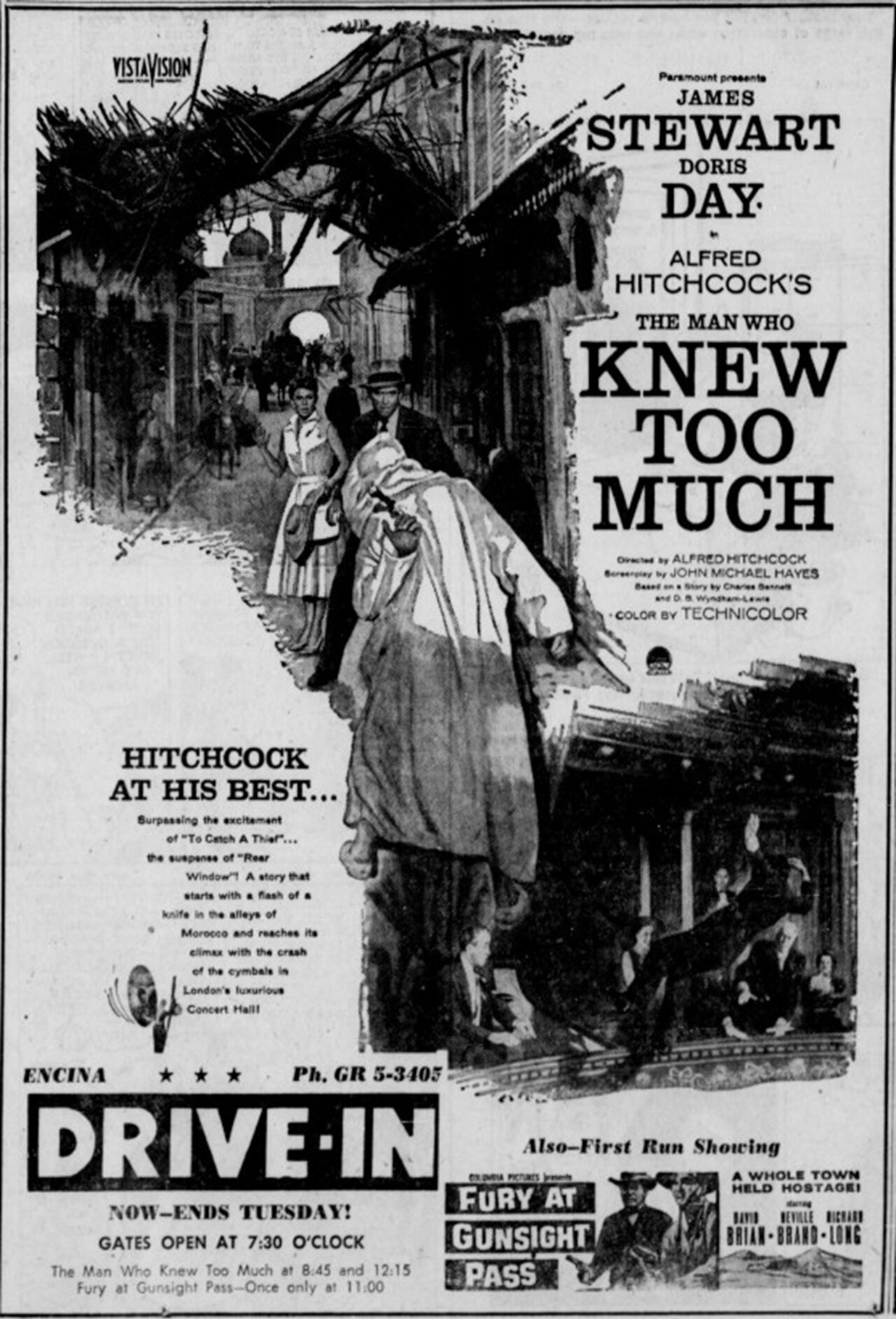
Mystery, suspense, Jimmy Stewart, and Doris Day – what’s not to love? Currently available on BBC iPlayer, Hitchcock’s Hollywood remake of his own pre-war thriller [1] is an exciting if, at times, uneven and downright weird picture.
It starts off in French Morocco, on a bus between Casablanca and Marrakech. We see a seemingly chance encounter with a well-spoken Frenchman, some good old fashioned Yank naivety from Stewart, and some pretty strange comments about Islam.
Jimmy Stewart is your archetypal middle class American abroad, a doctor named Ben McKenna, accompanied by his beautiful singer wife Jo (the incredible Doris Day) and his wisecracking all-American son, Hank. Gee whizz, I found that kid annoying. “I hope he gets kidnapped”, I comment, fatuously, shortly before he is, in fact, kidnapped, by a slimy English couple who befriend the McKennas in Marrakesh.
The most problematic scene in the film happens early on, when McKenna literally drugs his wife before telling her the terrible news of little Hank’s mysterious disappearance.
Up til this point, there is much intrigue and potential for political machinations. Was the mysterious Frenchman all he seemed to be? Is Doris Day a double-agent from the nascent Israeli Secret Service? Do Moroccans really insist on only eating with three of their fingers? Why is that American child so annoying?
However, once a heavily sedated Mrs McKenna agrees with her husband, the plot settles down into a more predictable adventure back in dear old Blighty, with some hapless local coppers, posh theatrical friends from Jo’s former superstar career, and some beautiful Hitchcockian oddness.
A highlight in grotesque is McKenna’s wild goose chase to a Camden taxidermist, who may or may not have something to do with Hank’s disappearance. Confusion and grimacing English folk abound, as workmen fight a flailing Jimmy Stewart amid stuffed tiger heads and half-defenestrated zebra torsos.
The film builds to a beautifully crafted set-piece at the Royal Albert Hall, involving a 12 minute long dialogue-free sequence, an extremely slimy would-be assassin, and a fabulous orchestra. Doris Day – spoilers ahoy – saves the life of the PM of some made-up central European country, one that comes across only slightly less silly than Duck Soup’s Freedonia, and her charismatic singing and piano playing under extreme tension finally leads to the rescue of that infuriating child.
The film is very much of its time, as hopefully I have made obvious. There are flaws and oddities in plot and tone. It is not one of Hitchcock’s finest. However, the performances, especially from Day and Stewart, are exquisite, the pacing is beautifully done, and by the time we reach the denouement, all screams, significant glances, close-ups of door-knobs and pistols, it is as gripping as a cat stuck on a chandelier : you’ll want to be watching when it all smashes to the ground.
[1] with the same name as, but no actual relation to, the GK Chesterton story collection. It turns out that Hitchcock had the film rights to the stories, and liked the title…
 jamesofwalsh
Leave a comment