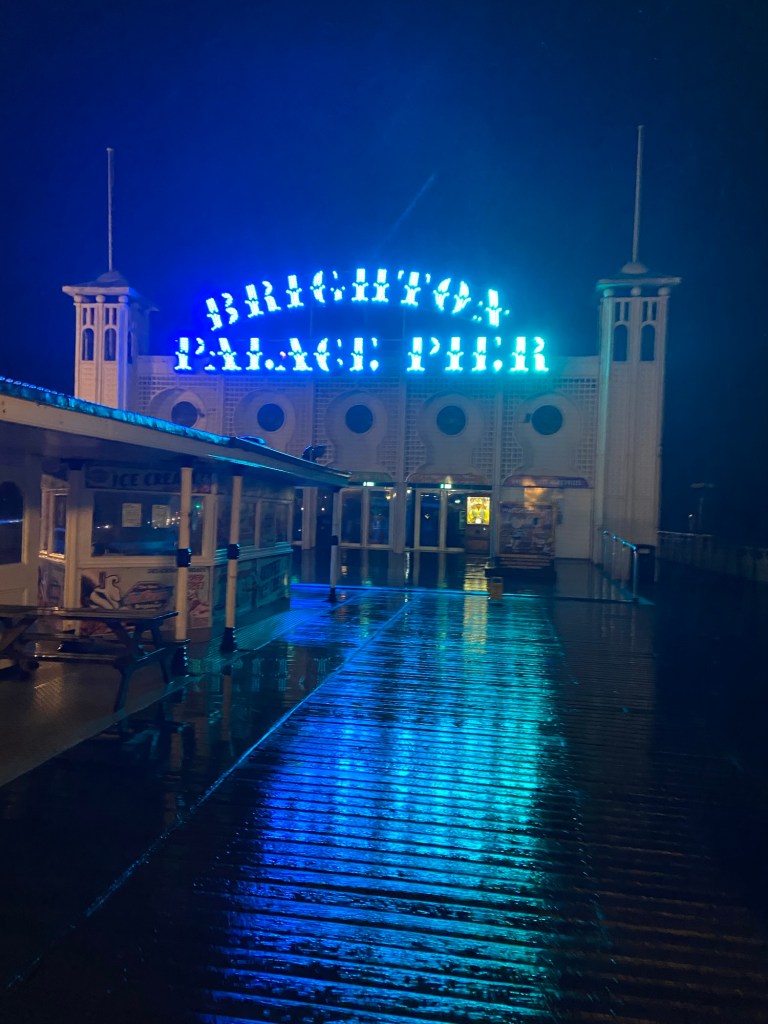
Tonight was an End of the Pier show – not in the traditional sense, but these talks with comedy greats did take place at Horatio’s, the old karaoke bar at the end of Brighton pier.
It was an interesting place to be on a dark and stormy night, and the waves looked garish in the reflected neon as myself and Simon Topping [1] made our way up past the closed arcades and deserted doughnut shops.
I’d been here once before, to sing with Brighton Folk Choir at one of David Bramwell’s Catalyst Club nights. This felt a similar audience: comfortably off boomers and gen Xers, but with a gaggle of League of Gentlemen obsessives down the front.
We will come to them later.
John Lloyd was first, and we were treated to a showreel of some of his finest moments. I knew he’d done a book with Douglas Adams, and had produced some comedy shows. It turns out he in fact produced both my sense of humour and my childhood: Hitchhiker’s, Not The Nine O’Clock News, Blackadder, Spitting Image. He was there for them all.
A very funny man in a leather jacket and a flair for the well-tailored anecdote, Lloyd was also wise, insightful, and humble. He espoused failure, because failure means trying, and trying is everything. He also highly recommended getting sacked, or being the fall guy for things, as this means you can go on and do something else.
But most of all, he was very good at explaining what a producer actually does, and why the talent get lauded when a show succeeds, and the producer gets the blame when a show fails.
His close friendship with Douglas Adams is explored – Lloyd clearly misses him dearly – and we find out that his entire television production career came pretty much out of Adams cutting him out of the Hitchhikers book deal. We also learn that Atkinson is basically an engineer of comedy – a technician, obsessed with how everything fits together, and capable of boring Princess Anne to death when asked to compare different types of filming – and how Lloyd oversaw the very moving end to Blackadder Goes Forth. Stuck in the edit suite with some useless footage, he explains how these people not only salvaged it, but created something timeless. He is very honest about his part in it – essentially, he did everything, and nothing – and when he brought the tape home to his girlfriend, she watched it until the tape was just fuzz, tears pouring down her face.
Lloyd was asked in the Q&A what stuff he liked now in terms of comedy, and he said Pixar, because they seem to be the only people doing what he was doing in the 80s: making stuff for everyone, stuff the entire family could watch. He and I – I do butt in – agreed that there’s a dearth of television comedy being made, other than bloody panel shows, because they’re so cheap.
The talk didn’t touch on Spitting Image, so I asked a question about it: did they realise at the time how revolutionary it would be, and why was the original show so brilliant and why is the new version so shit?
“You’re right, it is, but I might have to explain that one in the bar…”.
In fact, he did explain, and he explained it well. You need to make something new, and fresh, and exciting, and something that’s never been done before. “Some of the people working on Spitting Image genuinely did want to overthrow the government… if anything, I think we made it last even longer.”
“The people working on Spitting Image now – some of them are friends of mine, they’re good writers – they’re estalished, middle aged men. It’s not a passion project for them.”
There was actually something quite punk about how John Lloyd viewed creativity. He seemed to view people not actually knowing what they’re doing to be the best way of going about things, because that way you can’t help but be original. He also remembered some good advice: if you make something that you yourself like, then that’s already one person that likes it. There’s a chance you might strike a chord with other people too. Whereas if you’re just trying to guess what other people like, you might end up making something that’s enjoyed by nobody at all.
The second half was Steve Pemberton, who got a much bigger reception than Lloyd. It makes sense I suppose: he’s a star of stage and screen, whereas Lloyd lurked in the shadows. I have to confess to not really being a massive League of Gentlemen fan, though it was, disturbingly, my dad’s favourite show. It sounds like Pemberton has gone on to do many amazing things since, and speaks very earnestly and seriously avbout them. He clearly takes comedy, acting, and comedy acting, very seriously indeed.
We learned that the shop in League of Gentleman was inspired by a shop in Rottingdean.
As sketch and character performers, me and Simon felt the ideal audience for Pemberton, who – not a natural racounteur like Lloyd – was happy explaining how the characters from League of Gentleman were built and developed over time via the stage, with minimal props, wigs, or make-up. They made characters so compelling that audiences would come back and want to see these characters in new situations. By the time they came to make the television series, these characters were as fully formed and believable as that guy who walks around Brighton all day in an addidas tracksuit. You know the guy I mean.
Simon got the final question of the night, after a series of hyper-nerdy young League of Gentlemen fans asked extremely niche questions in the vein of the Itchy & Scratchy fans in Itchy & Stratchy & Poochie episode of The Simpsons.
His question was about live comedy, and sketch comedy, and how the pathway that both Pemberton and Lloyd’s peers took – sketch comedy, radio comedy, and then multi-camera television comedy – is almost extinct now. He even managed to plug his own night, which I was super impressed with – and asked Pemberton to become a patron of it! Cheeky fella.
But Pemberton agreed that working through characters in front of an audience is crucial. “Writing sketch comedy – and learning how to do that well – is so crucial before going on to attempt a 20 or 30 page script”.
He’s right, and Simon encouraged the whole audience to keep supporting live comedy. Maybe by starting on Saturday, at Extra Topping.
There was, to conclude, a raffle, with prizes including VIP treatment at a QI recording, League of Gentlemen DVDs, a Doctor Who Tom Baker remastered vinyl recording, and a Fatboy Slim memior signed by the man himself, who was somewhere in the building. [2]
I did not win any of these. However, while I was waiting for Simon to talk to Pemberton after the show, something magical happened.
The guy next to me was talking about how he’d won something, and I butted in and said I was planning to mug whoever it was who won the Doctor Who record and throw them off the pier.
He looked at me for a second, startled, and said, “I was the guy who one the Doctor Who record”, and picked it up off his chair.
“You can have it if you like, I don’t own a record player and haven’t watched Doctor Who since Pertwee.”
“Thank you so much!”
“It would have gone straight on ebay tomorrow morning otherwise.” [3]
Clutching my glorious prize, I took a photo of Simon, who had reached the front of the queue to meet Pemberton.
“Together at last,” I said, as they posed. “The past and future of comedy”.
Several people gasped, Pemberton laughed, and the photo came out beautifully.

[1] Rival Brighton alternative comedy promoter and friend.
[2] In Brighton you’re rarely more than six feet away from Fatboy Slim.
[3] He had won not one, but two raffle prizes, which is why I think he was happy to give the record to me, even though I had just accidentally joked about killing the person who won it to the person who had actually won it. He was also slightly tipsy.
 jamesofwalsh