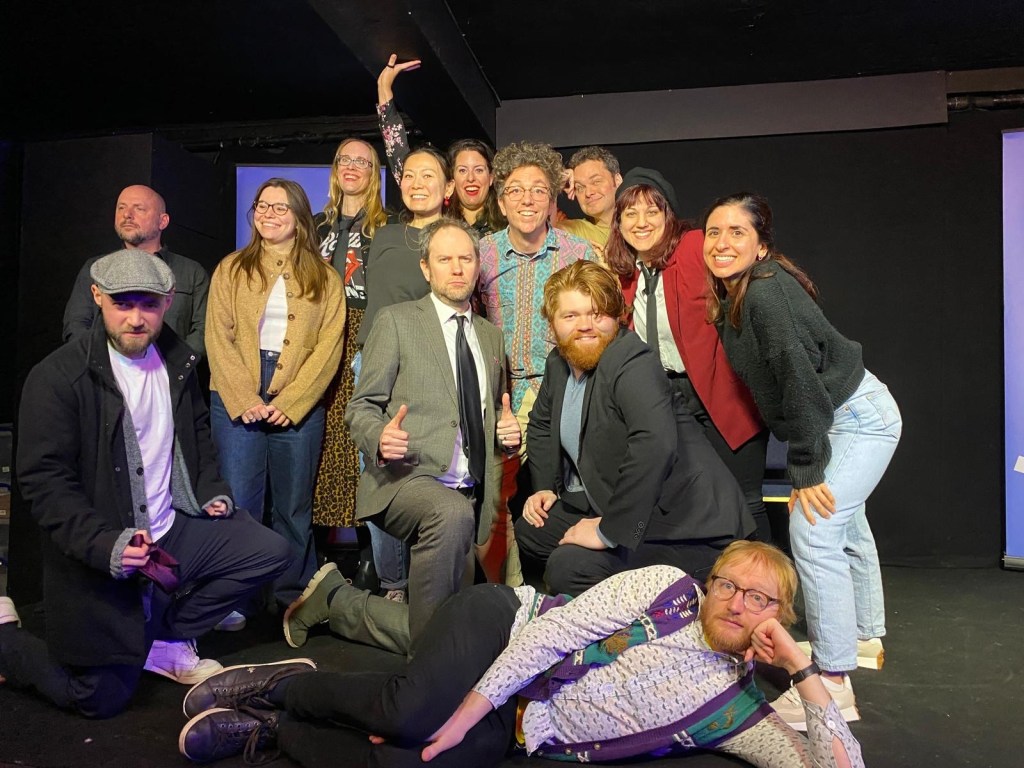
I’ve been up and down to London like a cockney yo-yo the past few days. Thursday: a sketch rehearsal at Theatre Deli in the city, followed by a show at Hoopla Impro in London Bridge with some visiting pals (one a big improv enthusiast) from Istanbul. Friday: an improv session with an experienced improviser, Melissa from Michelle, in which we workshopped this new “Cbeebies” improv show we’ve been working on. And Saturday: an afternoon sesh at Hoopla as part of their new House Teams programme, and then performing in the early-evening pre-party with a brand new format.
I wasn’t expecting for improv to return into my life with such gusto. Hoopla’s invitation for me to join this programme came somewhat out of the blue, given I applied and auditioned almost two years ago. When I got the email confirming I was in, major imposter syndrome followed – it very much felt like a stork had delivered a baby to the wrong guy. But then I thought, just go with it: as the old proverb goes, if the world gives you baby elephants with enormous ears, make circus performers.
The house team sessions have been run by Steve, King of Hoopla. He’s a very strange and very interesting man, who follows whims while also evidently thinking very deeply about what improv is and how it can be made more entertaining. It’s been fun watching him come up with and develop new formats in real time, and his feedback has been very useful and very audience-focused. In this most recent session, a lot of the time was spent just getting back to the nuts and bolts of the who-what-where – establishing who the characters are, and what their relationship to each other is; what the scene is about, and where the thing is taking place.
In sketch comedy, often the first thirty seconds of a sketch are crucial – unless you’re specifically hiding something for a big reveal, the best laugh [1] in a sketch is the one where people in the audience GET it – they understand the game of the sketch, and relax and just enjoy whatever it is that’s about to unfold.
In improv, sometimes the performers forget to let the audience in on what’s happening. Those on stage might know that one of them is an incompetent questing Knight and the other their luckless assistant, but the audience might think that’s just a plank of wood you’re holding, not a lance. It seems cringe, but sometimes it’s very helpful to just say the thing.
The new format we tried out was called “A Rough Guide To London” [2]. Steve had brought along a couple of guide books, and we did scenes based on whichever entry the audience member read out.
The idea was to start with a scene VERY OBVIOUSLY inspired by whatever listing was read out, and then to have other scenes unfold out from there, but also returning to the initial setting if useful or interesting. For this to work you needed very quick edits.
Ironically as an IRL editor, I’m still getting used to the editing process in improv, and gaining confidence in when the best time to do it is. As a more experienced performer said to me yesterday, “no improviser ever wished for slower edits.” When you’re standing at the side of the stage, watching your team mates in a scene, it’s very much your job to be helping them – and the best way to do this is to pick the perfect moment to either sweep in as a new character, or decide that the scene has reached its most interesting point and it’s time to go on to the next one.
In a nutshell, it kinda feels inherently rude to go “we skip to…” and initiate something else, but it’s the opposite of rude: you’re helping the person on stage by ending their scene in its prime, before it runs out of steam and leaves the performers floundering.
Being off stage is, therefore, just as important as being on it, as you’re constantly thinking about one, very important thing: how to make your fellow performers look good.
In this, improv is essentially anarchism – in its actual meaning, not in the “euphemism for chaos” way the capitalists use it as part of their ongoing attempt to convince us that we can’t have nice things, ever.
Over the course of the show, I performed as the boss of the Wellcome Collection, one of the (in our version) wealthiest charities in the world, with rooms dedicated to gold and diamonds, and Mr Thomas Crapper, inventor of the toilet who also seemingly insisted on being present for every customer’s specific bowel movement, standing ready with a mahogany chain, ready to flush, and boasting that the toilet seats are made of stone from the Elgin Marbles themselves.
This particular bit ended with us skipping back to Mr Crapper at home, his wife furious with him for his toilet-flushing obsession, and his daughter asking him to wipe her arse.
Actually being in a scene is, unfortunately, where all the improv theory goes out of the window, in my case. I enter flow state (much like one of Mr Crapper’s toilets), and have zero ability to remember anything I’m supposed to be doing. My mind is beautifully empty and beautifully free.
At the side of the stage, however, I am able to do the thing of listening carefully and choosing a good moment to end a scene, but at the moment I’m being too timid. The best time to initiate a new scene in right now, and the second best time is a few seconds ago.
This is what I am telling myself, but it’s jarring with a slight fear of seeming rude (see a few paragraphs above), and also another, slightly bigger fear of being seen to be hogging the spotlight or making it all about me.
These are complicated ego-suppressant, second-guessing tendencies that have no place in improv, and I shall be working hard on allowing the flow state to emerge even when I’m on the sidelines.
Because I really, really, really want to make my fellow players look good.
And I suppose that’s a good start.
[1] At least, from the perspective of being on stage…
[2] I got the impression naming the format hadn’t actually occured to Steve until he was announcing it on stage to the audience, which is very improv.
 jamesofwalsh
Leave a comment