
Due to insomnia I’ve been rewatching Filmation’s original 1983 He-Man, a cartoon designed (successfully!) to sell the child version of me toys of body-building blue skeletons and ripped, blonde, quasi-barbarian heroes.
In terms of plot, dialogue, character development, and animation, He-Man is largely dogshit, with one exception: Skeletor’s relentless commitment to evil is pleasing and divertingly uncomplicated, and enthusiastically performed by voice actor Alan Oppenheimer.
In the wee small hours I started thinking about Eternia’s exceptionally stark gap between rich and poor, and how the authoritarian monarchical dictatorship of Prince Adam’s father, King Randor, hoards both technology and resources while leaving most of the planet’s population to rely on subsistence farming.
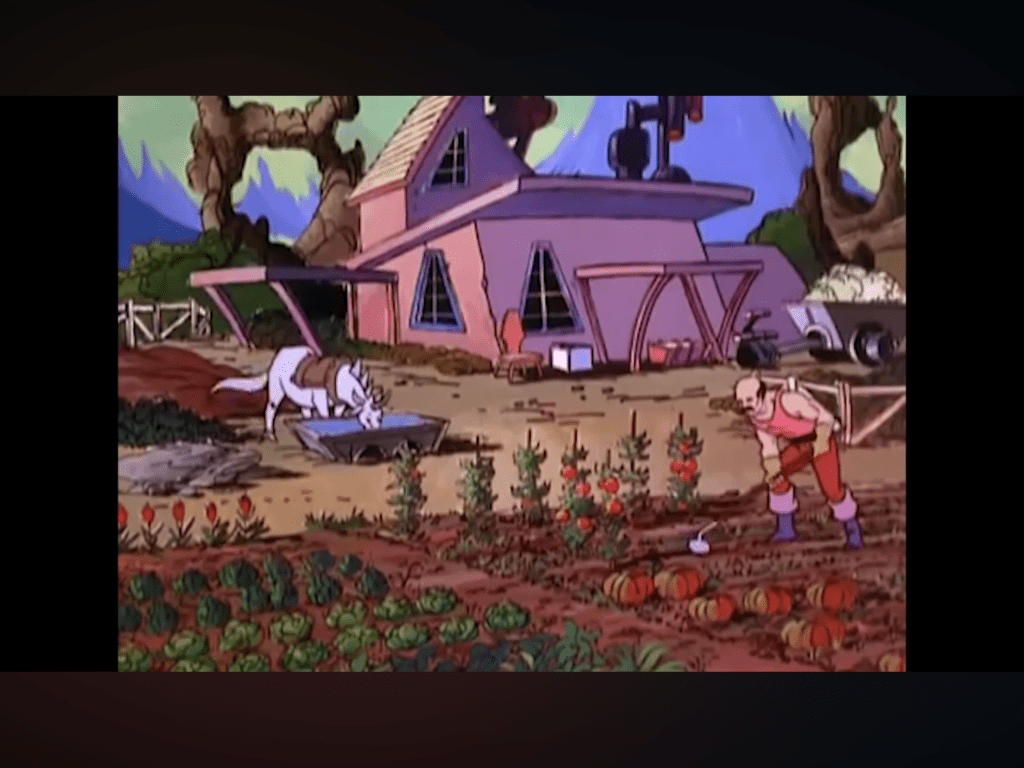
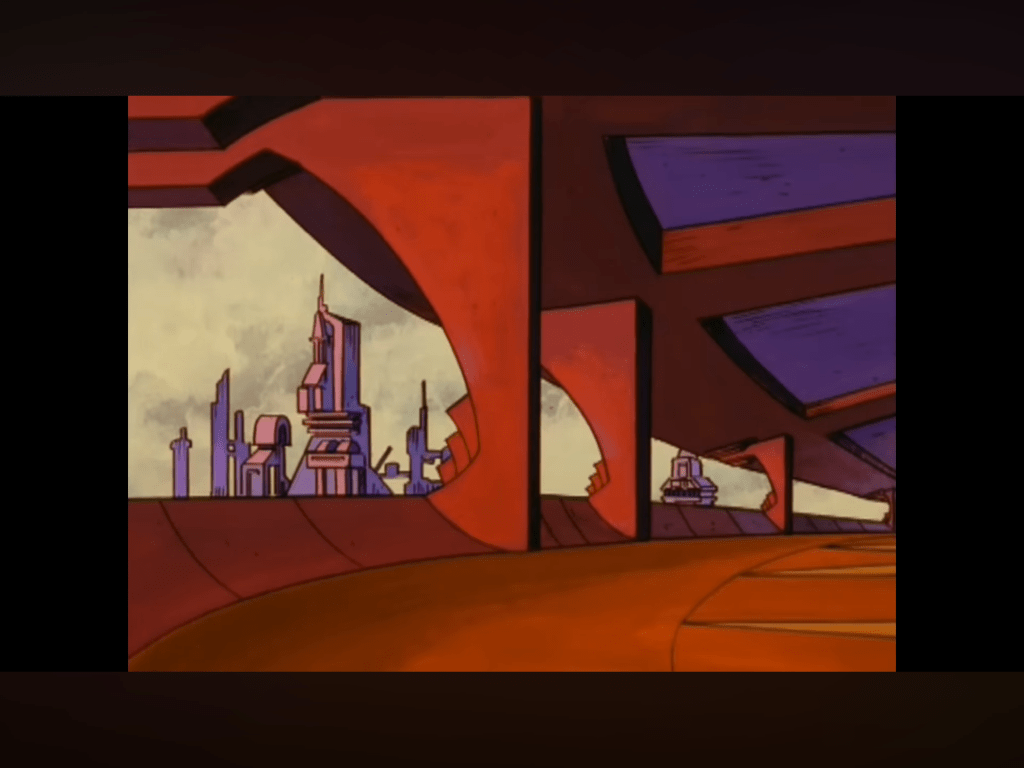
The planet’s capital, Eternos, is a Metropolis-aping fever dream of thin towers and wide, elegant walkways. Here, a tiny, privileged elite live, protected by the sinister, moustachioed Man-At-Arms and his army of militarised police goons.
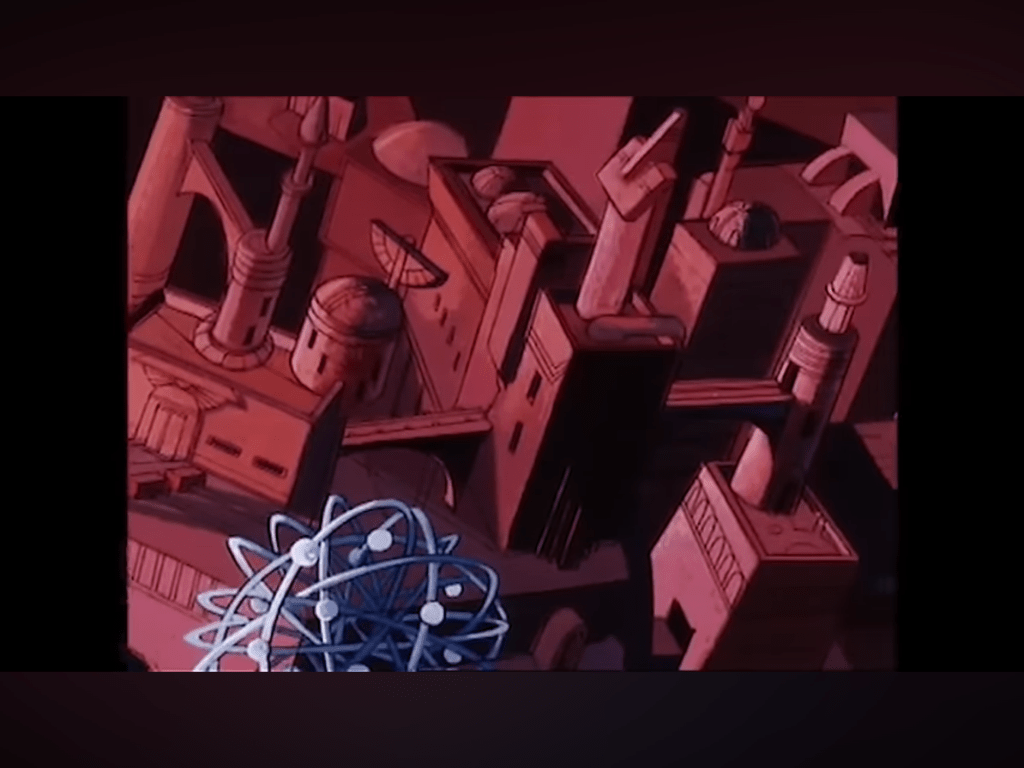
Atop Eternos itself is the royal palace, in which the King and his inner circle enjoy daily feasts and the cavorting and clowning of court magicians such as Orco.
While just outside the city walls, peasants dig the thin soils for a meagre existence, the royals literally have flying cars. Aided by the technological inventions and magpie-like cunning of Man-At-Arms, and the magic of Castle Greyskull, theirs is a gilded existence in an otherwise medieval world.
Adam, Prince of Eternia and heir to the throne, is depicted living a life of luxurious fatuousness, like a French royal shortly before the invention of the guillotine.
Eternia is clearly ripe for revolution, if it weren’t for one obvious factor: the existence of an alien other, in this case represented by the Evil Forces of Skeletor.
Unlike, say, the scapegoated, desperate people in small boats making their way across the English Channel, it does help King Randor’s cabal that the threat of invasion from Skeletor is not only true but seems to be attempted every week.
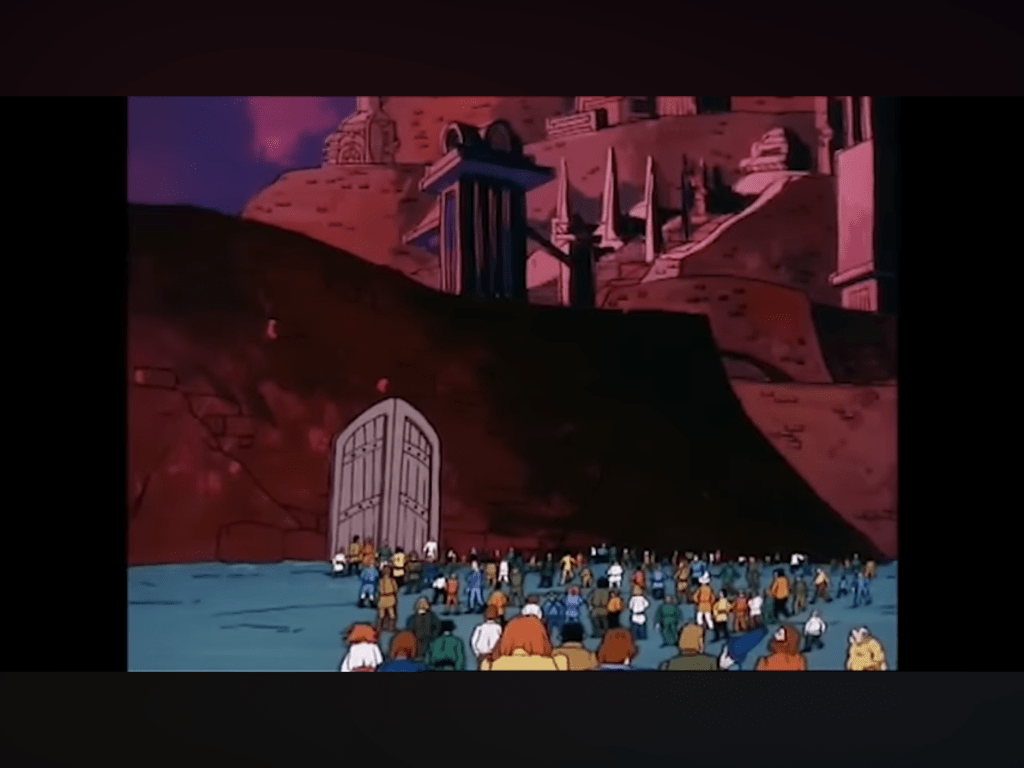
When Skeletor’s minions attack, the citadel-capital opens its doors to the peasantry, and defends them with its futuristic and mystical weapons. You will, though, note that these people are ejected from the city’s modern comforts as soon as the threat is vanquished.
The threat of war leads to patriotism, and He-Man seems a popular hero among the common folk. Interestingly, much of the hostility towards the elite represented here comes in the form of superstition: that the King’s reliance on technology is offending the old Gods and are a threat to the old ways.
There isn’t much in the way of materialist analysis in He-Man. While it seems clear the elite has sidestepped a period of Industrial Revolution by keeping the peasantry trapped in agricultural bondage and – thanks to Skeletor – in a state of perpetual war, we don’t hear much about the day to day lives, dreams, and hopes of the people either. And what of those trapped in the cavernous slums outside the capital, without even a smallholding of their own?
To quote Marx:
Political economy,… does not recognise the unemployed worker, the workingman, insofar as he happens to be outside this labour relationship. The rascal, swindler, beggar, the unemployed, the starving, wretched and criminal workingman – these are figures who do not exist for political economy but only for other eyes, those of the doctor, the judge, the grave-digger, and bum-bailiff, etc.; such figures are spectres outside its domain. For it, therefore, the worker’s needs are but the one need – to maintain him whilst he is working and insofar as may be necessary to prevent the race of labourers from [dying] out.
This feels about right, though there seem to be few, if any, judges or doctors in Eternia. There also seems to be little in the way of an education system, beyond oral tradition and the perpetuation of the oldest tales. There seem to be zero hopes or prospects for a young Eternian beyond joining Eternos’ ranks of heavily militarised regime guards, or perhaps getting a plum job cleaning out the King’s royal privvy.
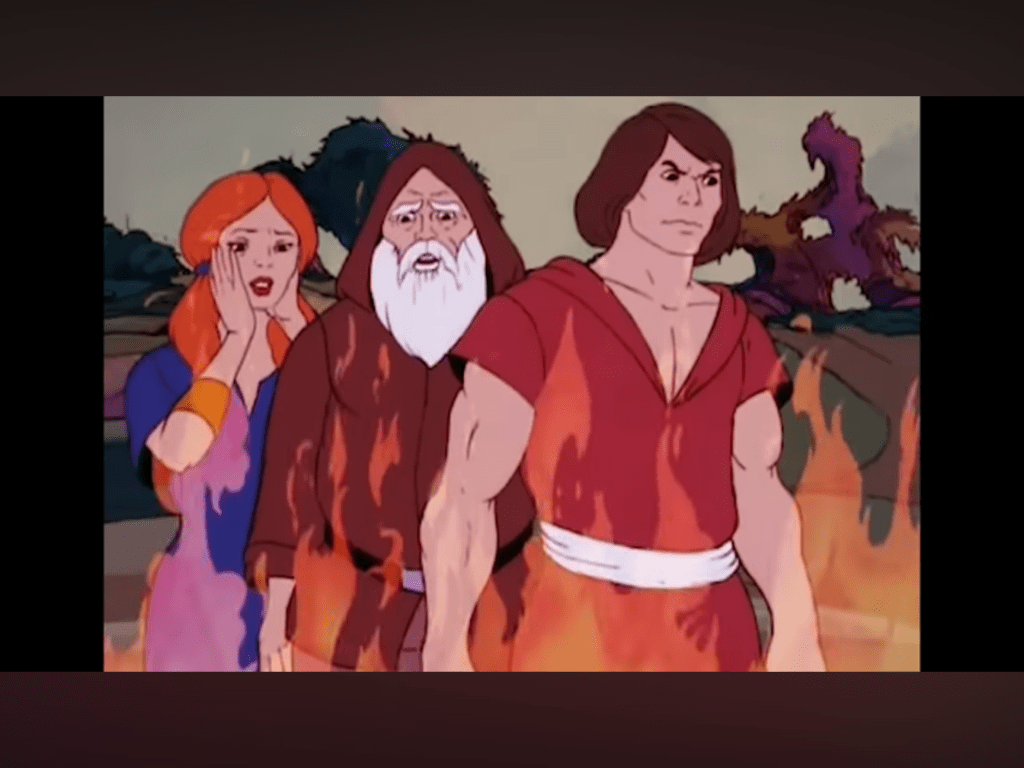
There is, however, hope. In one early episode, a peasant family’s cottage is burned to the ground, despite the efforts of Man-At-Arms and his daughter Teela, who appear to be the planet’s fire department as well as its military leaders.
Fire defeats Man-At-Arms’ futuristic contraption, and an old woman – Evil Lynn in disguise – starts spreading rumours about the King’s technology offending the old Gods.
This leads to an uprising, which is eventually thwarted. And this, I suppose, is meant to be good?
Perhaps it is. Nothing we see in He-Man suggests Evil Lynn or Skeletor would be wiser rulers than King Randor, or that they would be more enthusiastic about wealth distribution or overhauling Eternia’s outmoded political and economic structures.
On the other hand, maybe it’s time to give them a go.
 jamesofwalsh
Leave a comment