
There’s a kind of person who loves Terry Pratchett. A hoopy frood who always knows where his towel is. They could be neurodivergent, or maybe not – it doesn’t matter. They respect Brian May, as an astronomer. They’ve dabbled in steam punk, know Alan Moore better than he knows himself, and could quote any scene from Monty Python and the Holy Grail. They will, in the right company, argue that Meddle is the best Pink Floyd album.
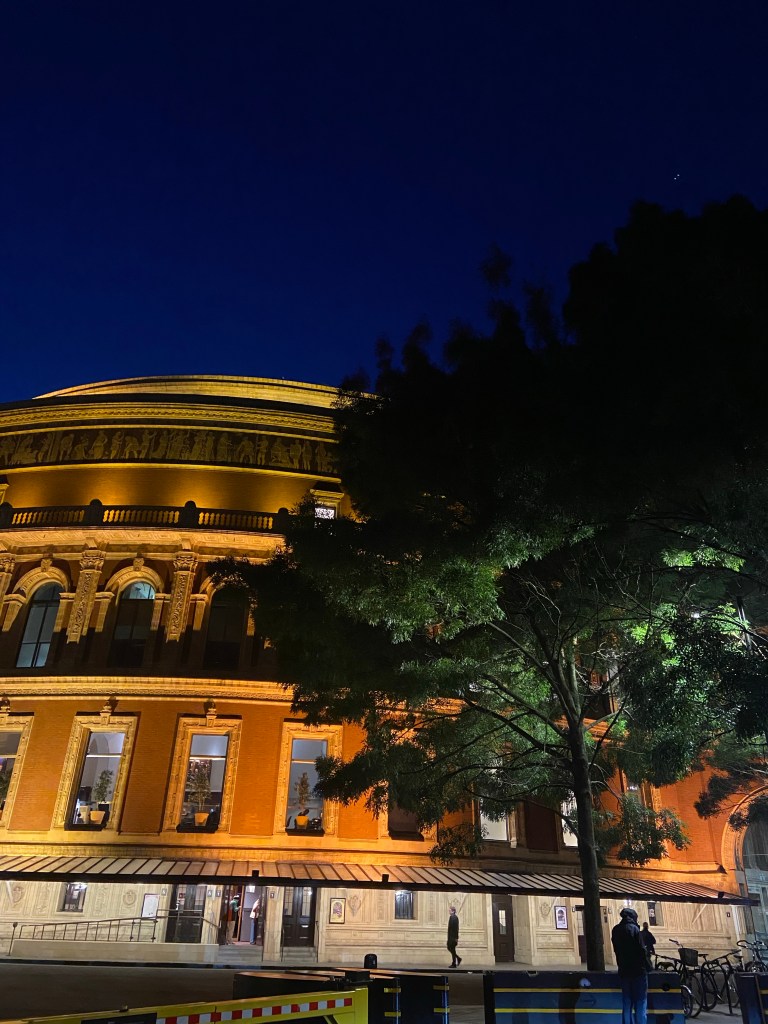
Late last month, me and thousands of other people broadly matching this description went to see Eric Idle at The Albert Hall. Some of them – again, like me – were with their mum.
“That’ll be a short show,” said my friend Alastair, when I told him what I was doing for my birthday. “Will he just do One Foot In The Grave and Always Look On The Bright Side Of Life?”
The comment rankled, but he had a point. “Don’t forget the Woolwich Building Society advert song,” I messaged back.
In truth, I had no idea what the show was going to be. The tickets were a present, bought months before; I’d almost completely forgotten it was happening.
The legendary man wandered on stage – in good shape for an eighty something, according to my fading eyesight from the Gods. He had a guitar and not much else. Perhaps Alastair was right.
But soon, the format emerged. This was a mixture of career retrospective, anecdote, song, and the occasional video clip. There were jokes – some very fine jokes, especially in the first half. But this wasn’t quite a comedy show.
Idle, notoriously and openly the money-obsessed member of Python, was keeping things Spartan. Jarringly, he launched into The Meaning Of Life – a banger – with his backing band playing “live” on a massive video screen behind him, instead of on the stage with him. “Tight git,” I thought.
He went decade by decade, explaining how the Pythons met and formed – he made getting a television show sound like the easier thing in the world – and gave a few insights into the writing process. “We met up and read them out. Those that made us laugh went in the show, those that didn’t we sold to the Two Ronnies.”
There was plenty of Python – what most here were here for. Seeing how they broke America was particularly fascinating, them appearing on late night telly shows performing characters that must, to a suburban postwar American, have seemed beamed from another universe.
In this world where so much is mediated by algorithm, and telly is a musical and comedy desert, it’s bizarre to see Idle’s preposterous innuendo character on American TV alongside staid Hollywood stars and earnest rock and roll bands. Bits of Python have dated badly, and become dull through repetition, but plenty of it still works. For it to explode into the still grey late sixties and early seventies cultural landscape must have been genuinely comparable to the impact of The Beatles.
The Beatles are the other comparison point all night, with Idle speaking movingly about his friendship with George Harrison, and the brilliantly inappropriate jokes he made at his funeral. His name dropping is legendary, and we get plenty of it here. But his friendship with Harrison was the real deal, the quiet Beatle literally remortgaging his house to get The Life Of Brian made (Harrison’s explanation: well, I want to see it”). He sings a song he’s written about Harrison, sincere, earnest, but forgettable.
Talking of The Beatles, Idle wrote the absolute note perfect Fab Four parody, The Rutles, and pays tribute to the late Neil Innes, who wrote those perfect, perfect, almost-but-not-quite faux-Beatles masterpieces. It would have been nice to hear a bit more about this, and maybe one of these brilliant songs, but this is Idle’s show. He talks fondly of his years in Hollywood, and speaks movingly about Graham Chapman and trying to get a mentally ailing Robin Williams to guest at the last-ever Python arena show at The Millenium Dome.
He also, as the crowd psychically demands, makes digs about John Cleese’s many divorces.
We finish with Galaxy Song, featuring a baffled-looking Brian Cox, and of course, Always Look On The Bright Side of Life. Then, in a bizarre twist, Idle’s backing band come on stage for hugs and bows – they were in the audience all along! So why not have them play the songs?! The man is an enigma to the end.
I’ve been reading Post Capitlaist Desire, a collection of lectures by the late Mark Fisher. In it, he and his students discuss art and creativity in a post-money, post-scarcity world. He uses The Beatles as an example:
What does a post-work society look like? It kind of looks like what life was like for them, doesn’t it? They didn’t have to work. They’d made enough money, surely, by the early Sixties to just not work. Then their most interesting, experimental stuff emerged. Their most interesting, experimental stuff emerged partly because they were freed from the pressure of having to worry about a salary – they actually sold more anyway!
You get the impression Eric Idle never quite got to the point of not worrying about making money. He is still out there, doing it now, and was always the Python trying to keep the whole damn thing afloat, to be economically viable in a world of movie deals and merchandise tie-ins and musicals and John Cleese’ many divorces.
Perhaps a post-scarcity Eric Idle doesn’t exist. I am, however, delighted that the late capitalism Eric Idle is still with us, reminding us of that time Paul McCartney gave him a hug, and rightly valourising his part in some of the best art of the late 20th century.

 jamesofwalsh
Leave a comment